

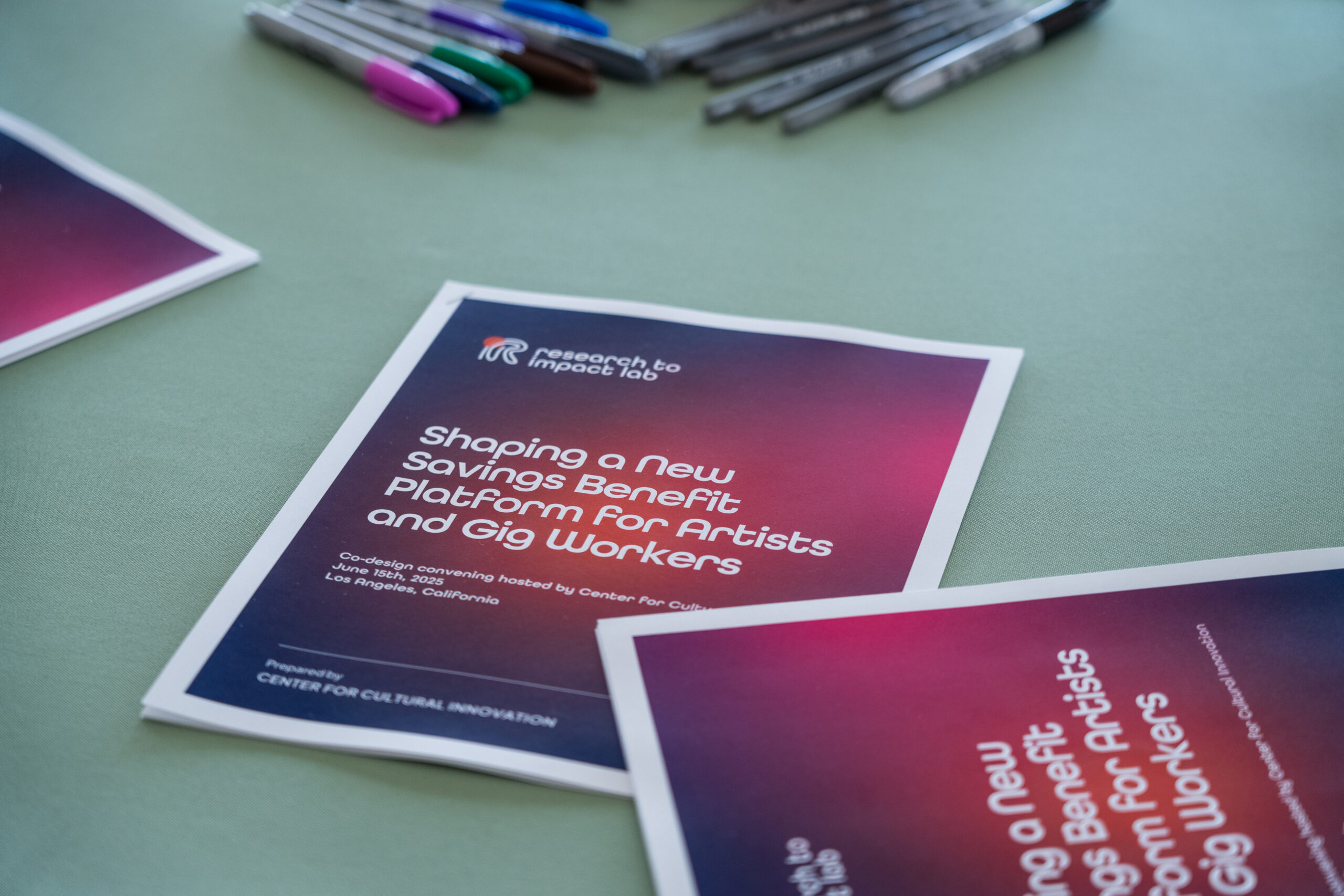
Shaping Collective Futures: Co-Designing A New Social Safety Net for Artists and Gig Workers
A behind-the-scenes look at the Cookie Jar Collective convening, where artists, technologists, and policy leaders came together to reimagine savings as a shared resource and explore new models of digital public infrastructure.
Why a Convening?
On July 15, 2025, the Center for Cultural Innovation hosted an in-person co-design convening in Los Angeles, California titled “Shaping a Savings Benefit for Artists and Gig Workers.” The goal of the convening was to bring together a diverse group of stakeholders–including artists, technologists, and policy experts–to engage with an early concept for a technology-enabled system designed for artists and independent workers to pool their savings and collectively decide how and where to spend, loan or invest it. The project is informally called the Cookie Jar Collective.
Our team decided to host the co-design convening because, while we had a semi-clear conception of the tool, we still found ourselves bumping up against many key implementation questions. We had conducted thorough background research, engaged with artists in focus groups, and hosted a technology-focused co-design session at DWeb Camp ‘24, yet we still did not feel confident enough to start writing any code–perhaps because this project has highly ambitious goals.
Our main goals for this system is to help grow the financial security and social cohesion of independent workers. Not only that, but we hope that our system can inspire a shift in the way people relate to money–to see it less as individually-held resources and more as shared resource commons held in communities of trust and governed by mutualistic, cooperative, and solidarity-oriented agreements. The model is based on the concept of Rotating Savings and Credit Associations (ROSCAs, sometimes called tandas or sou-sous) that have been present in communities of color in the U.S. and abroad for generations. We are building on that legacy of mutual aid with the Cookie Jar Collective. Our hope is that we can leverage new technology to scale this idea to a large number of freelancers.
Finally, we aim to demonstrate how U.S. policy makers can use our system to expand benefits for non-traditional (non-W2) workers, a growing share of the workforce who are excluded from a social safety net that only protects those engaged in traditional employment. We realized our ideal roadmap for this system would include it potentially being adopted by a state or local government as a “public option,” similar to state retirement funds like CalSavers that are available to freelancers on an opt-in basis.
These social, cultural, and policy change goals required us to engage early with a broad range of stakeholders, making the participatory model of co-design an ideal design step for this project. This is the Research to Impact Lab’s first incubation project, which means that we are testing different aspects of our technology incubation process and learning along the way. What level of participation is useful? How can we move quickly and keep learning along the way? We’re not a government, though we do intend this product for public good; and we certainly aren’t a tech start up, though we want to be able to innovate swiftly. As a result, we strive for a balance of participation somewhere in between democratic governments building public infrastructure and traditional technology startups building products for profit.
Building digital public infrastructure means not seeking profit but rather seeking positive effects of relationality, participation, social cohesion, diverse opportunities, mutual support and benefit, maintenance, and care.
Our Planning Process
The R2I Lab team engaged in an approximately 9-month process to prepare for and plan the co-design. We began with a selection process for a human-centered design firm partner with whom we would collaborate on the convening design and facilitation. Greater Good Studios (GGS) was ultimately chosen as our partners because of their prior experience working on technology that directly drives state-level policy change.
With GGS’s support, we proceeded with our participant selection process. It was crucial to our team to meet with each prospective invitee individually to connect with them on a personal level, hear about their work, practice explaining our concept directly to them, field any follow-up questions, and gauge their interest in collaborating on the project.
Once we had our twenty-two total participants confirmed, we worked on designing the agenda–again, with the help and guidance of GGS. The whole experience was intentionally designed, including a welcome dinner the night before the convening, in order to create a space for folks to meet and connect across their areas of expertise and interest. On the day, our agenda included three distinct segments: 1) introductions and weaving connections between participants, 2) building a shared understanding of the concept and fielding questions, and 3) collaboratively designing systems with different constraints in small, assigned groups. These segments were cushioned with meals (breakfast and lunch), breaks, and time for conversation and connections.
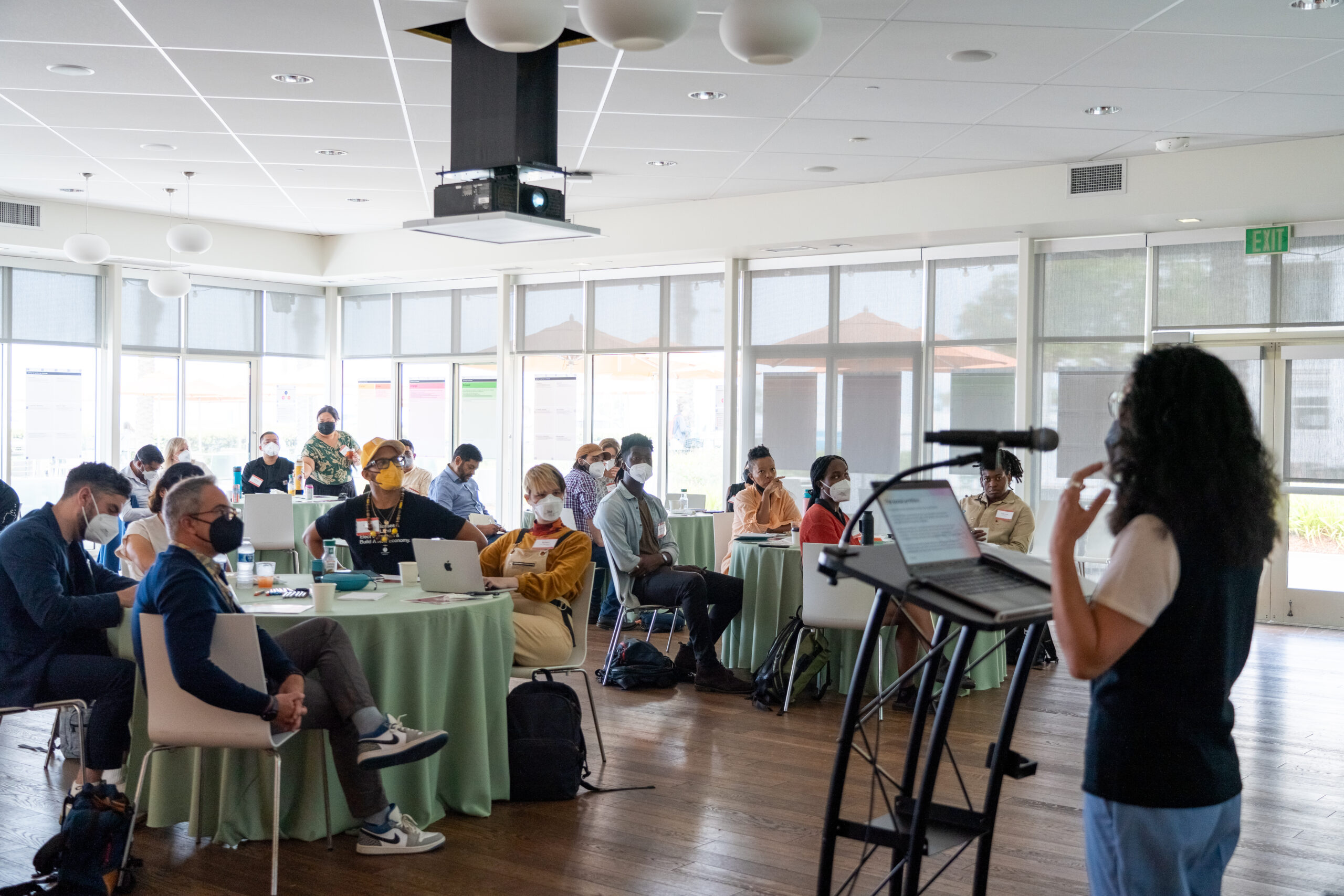
The Flow of the Agenda on the Day
The event transpired smoothly in that we remained on schedule with plenty of time for each program activity and suitable break time in between.
Each segment on the agenda flowed nicely into the next. Having each participant introduce themselves allowed other folks in the room to build bridges across domains of expertise yet trust in everyone’s values-alignment. Participants expressed the immense value in the diversity of perspectives present in the room including: technology builders from web3 and the decentralized web who recognize the importance of shared governance; leaders of existing tech-enabled mutualistic projects (i.e. Kola Nut Collaborative, Boston Ujima Project, Freelancer’s Union); career policy experts who focus specifically on benefits and safety nets for a changing workforce; Biden administration Department of Justice appointees as well the founding director of CalSavers, a public option retirement savings program; and of course artists who specialize in solidarity practices in their communities, leading cooperatives, collectives, and other mutualistic efforts either utilizing tech or in analog spaces.
In the second segment, we presented the most updated vision of our concept and invited participants to share reflections and ask clarifying questions. We told them, “Take our concept but hold it loosely.” This segment produced a lively Q&A where participants were able to massage the ideas presented, question assumptions based on their own work and experiences, and start to form their own internal vision of what the tool is, how it might work, and where it might be implemented. We were met with many of the same questions we, as a team, have been wrestling with. However, with these key questions in everyone’s mind, we were laying the groundwork for the final exercise–where we formed small groups to answer these questions given different sets of constraints.
Each small group was given one of the following scenarios for the concept: 1) subsidiarity/federated model, 2) platform cooperative, 3) public option, 4) VC-backed app, and 5) DAO/Web 3 version. Using these scenarios, the groups envisioned what the Cookie Jar Collective could look like and answered questions such as: “What is the role of technology?”, “How large are the shared funding pools?”, “What does shared governance look like?”, and more. During the share-outs from this exercise, heard five different manifestations of the concept–each making its own tradeoffs in order to conform to its given structure while accomplishing the project’s goals.

Our Takeaways and an Unexpected Surprise
The convening demonstrated that the problem we are trying to address–the lack of financial security / safety nets for artists and independent contractors–is deeply resonant and there is a hunger for solutions to this problem. Participants felt excited and inspired to be brought together to work with others on designing innovative, more community-driven and collectively-governed solutions to this problem.
- There seemed to be agreement that the solution is complex and therefore requires multi-disciplinary and cross-sectoral collaboration. Many participants expressed the positive value of gathering together in-person and with individuals from such diverse backgrounds and experiences. Many wished the convening could have been longer than just one day because of this complex nature of the system design. In a follow-up form, more than half of participants have expressed interest in continuing involvement in this design process–from technology development, pilot design, user research, partnership development, and more.
- There were elements from each of the 5 scenarios expanded upon at the convening that our team is interested in incorporating into our pilot. Therefore, rather than trying to come to consensus around one singular version of the Cookie Jar Collective, we are working on shaping a list of 2-3 versions around which we can design small pilots with groups of artists from CCI’s core constituency as well as adjacent partner communities.
- As for next steps, we will design and share our pilot program in the next couple of months and conduct outreach to prospective pilot participants and communities–including many of the co-design convening participants and their respective communities. We are also going to be hiring a founder to lead the development of the technology-enabled features of the tool.
- One unexpected surprise was how the success of this convening informed internal conversations within CCI about best practices for building out its relational infrastructure–processes for relationship-formation across multi-disciplinary, cross-sectoral groups to unlock potential future partnerships for our work but also for each participant and their specific projects.
Overall, the convening allowed our team to share the in-progress development of the Cookie Jar Collective concept and receive extremely constructive feedback. We believe that doing so early in the project’s design is essential not only for effective design but also for generating buy-in from the public, private, and civil society sectors. Continuing to build in participatory ways, we believe, will help ensure we don’t repeat past mistakes and that we build something that stands to weather changing economic and political conditions–as good digital public infrastructure should.
We look forward to the next phase of this work!
Read the Co-Design Convening Summary HERE
Read our Concept Brief HERE

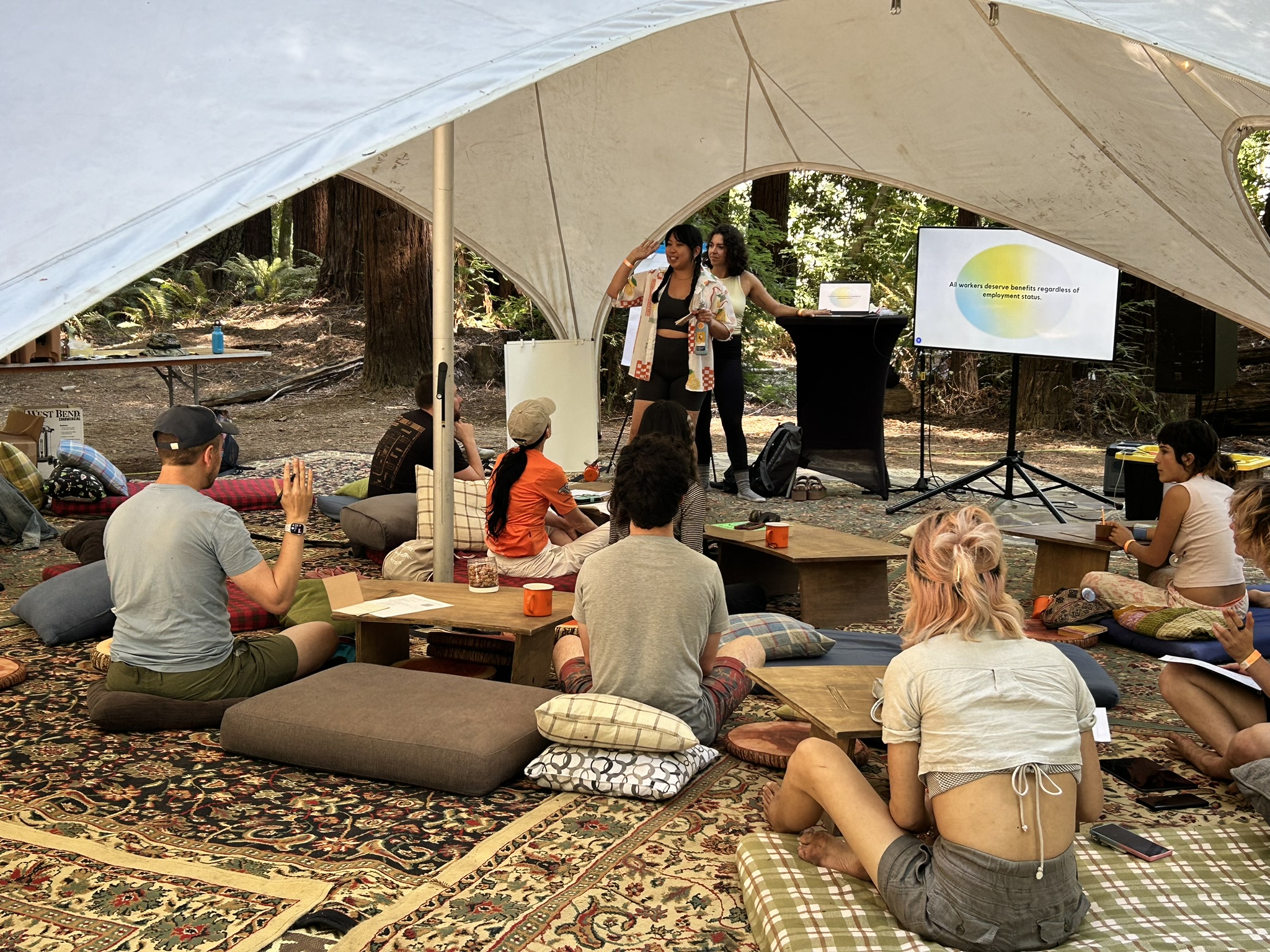
CCI at DWeb Camp 2024
CCI at DWeb Camp 2024
Reflections on our Co-Design and path forward
Systemic change to legitimize gig work won't come from band-aid solutions.
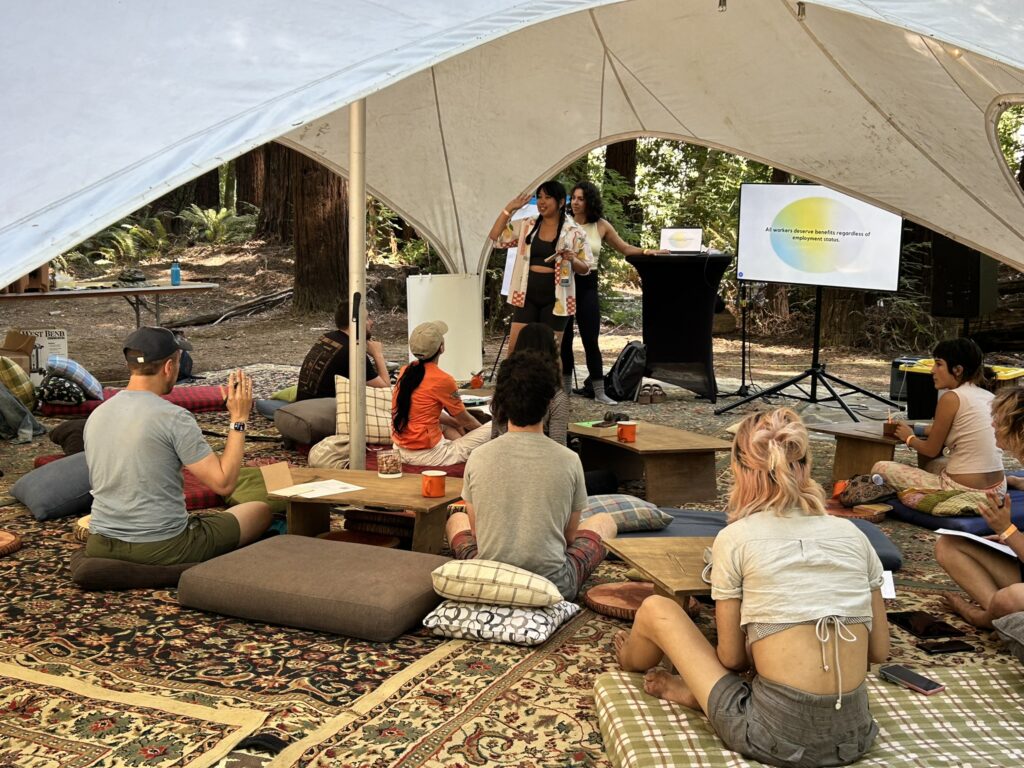
Research to Impact Lab's Senior Program Associate, Jennelyn Tumalad Bailon, and Enterprise Development Consultant, Val Elefante, facilitated a co-design for our gig worker savings club incubation project, currently known as "Cookie Jar Collective."
We welcomed 27 participants interested in helping us build a product that could facilitate shared accountability, community, and collective power centered on growing savings for gig workers.
Participants heard an overview of the purpose and journey CCI has taken to reach this point. They also spent time brainstorming and drawing different aspects of the product ranging from governance, UX design, and tech stack.
Watch the in-depth overview of our presentation, key takeaways, and next steps for this project in the video below.
Supporting Confident Creativity
Stanford and CCI Partner to Help Creatives with their Copyright Claims
For the vast majority of artists, some interaction with technology is not only unavoidable - it is necessary to rapidly create, produce and disseminate work as well as to ensure compensation. From blockchain to NFTs to Etsy, creatives use technology to connect directly with those who support their artwork. However, such technologies have also made it incredibly easy for that artwork to be pirated or misattributed. To protect their livelihoods, artists must learn how to protect their work from copyright infringement, as well as other lesser-known copyright claims that can impact an artist’s livelihood such as noninfringement and misrepresentation. The Copyright Claims Board (CCB) was created to make this process easier and less expensive for the average creator.
The Copyright Claims Board (CCB) was established in 2020 by Congress to answer an urgent need - the large volume of copyright claims and the limited amount of resources (time, expertise, money) available to creators to make those claims in federal court. The CCB consists of an entirely online process led by a three-member tribunal with extensive expertise in copyright law. The goal is a more efficient, less expensive alternative to federal court for copyright claims of less than $30,000.
And yet, like any bureaucratic process, this one can be challenging for those without an understanding of intellectual property law. CCI felt that it was critical to create a resource specifically for creatives so that they might learn how to navigate the CCB to protect their intellectual property rights. Through a partnership with the incredible students and staff of Stanford University’s Juelsgaard Intellectual Property and Innovation Clinics, we have created a live online resource for creatives to confidently navigate the CCB called Navigating the Copyright Claims Board: A Practical Guide for Creators!
What makes Navigating the Copyright Claims Board: A Practical Guide for Creators so special? Our Juelsgaard Clinic students found that since opening, the CCB has only seen a success rate of 1.5% of claims reaching a final decision (that is only 12 claims out of 721 filed).
This jaw-dropping number sparked our interest - how is it possible that a public resource set up to encourage independent creatives to take control of their IP should see such a dismal success rate? Our hope is that with this more accessible and interactive guide, artists and creative workers will feel more confident in their copyright claims.
To celebrate the release of this resource, please join us for the following activities:
-
- Confidently Informed: Navigating the Copyright Claims Board for Creatives on Thursday, June 6: a virtual workshop with the authors of the resource, Caitlin Cary Burke, Juelsgaard Clinic Member, Stanford J.D/PhD Candidate, 2025; and Kiran Wattamwar, Juelsgaard Clinic Member, Stanford J.D Candidate, 2025. Participants will get a tour of the guide and the chance to ask its authors any questions they might have about copyright protections. Register here!
- Confidently Registered: a Copyright Registration Party! on Thursday, June 20. CCI will host a virtual registration party! Register your copyright online with the Copyright Office. CCI staff will be on hand to assist you through the process. Register here!
- Share Your Story! Are you an artist or creative worker who has dealt with an issue related to copyright? If so, then share your story with us below! We’ll add it to a story bank to help us understand how we can support creatives with their copyright issues.
- Ongoing Activities. CCI will host resources and gatherings related to the needs of artists and in response to the research. Interested in partnering on this initiative? Contact Jennelyn Bailon at jennelyn@cciarts.org
CCI would like to thank the team from Stanford for making this resource possible:
Caitlin Cary Burke, Juelsgaard Clinic Member, Stanford J.D/PhD Candidate, 2025
Kiran Wattamwar, Juelsgaard Clinic Member, Stanford J.D Candidate, 2025
Phil Malone, Director of Juelsgaard Intellectual Property and Innovation Clinic, Mills Legal Clinic, Stanford Law School
Nina Srejovic, Clinical Supervising Attorney and Lecturer, Juelsgaard Intellectual Property and Innovation Clinic
Navigating the Copyright Claims Board: A Practical Guide for Creators would not have been possible without the support of the William & Flora Hewlett Foundation and the Kenneth Rainin Foundation

A Change in Name
A Change in Name
We are in the process of landing on the new name (hopefully, third time’s the charm).
In March 2023, we changed this program’s name from Rustle Lab to Sol Center for Liberated Work. As our work grew, Rustle Lab didn’t do enough to reflect our aspirations. In selecting the Sol Center name, we hoped to embed our aspirations for this work directly into the identity of the program itself. For us, Sol represented the energy of the sun to fuel new life and ecosystems. As a Spanish word, we felt it honored the immigrant and marginalized communities we hope to work alongside, as well as our California home. And it formed the root of other words that reflect the program’s priorities – solutions, solidarity, and solo workers.

Meanwhile, Liberated Work encapsulated our world-building ambitions. For us, liberated work was about self-determination by creating new systems that no longer equate “work” with “worth”; where the jobs we do to earn money do not dictate access to benefits, security, time to rest, or possibilities for the future. Liberated work is not just about how we pay our bills, but also the work we do to care for our families, participate in our communities, and freely express artistically and culturally.
When we rolled out the new name, however, we heard that it wasn’t landing in the ways we hoped. For some, Sol was too easily understood as Soul, and the deep cultural resonance that term holds for Black communities. In addition, Liberated Work was less understood as our stance on labor issues and, instead, perceived as borrowing too heavily from the language of Black Liberation movements. For others, the Spanish word Sol felt appropriating in the absence of LatinX leadership within our program.
As an arts and culture organization, we know that language and representation matter, so we have taken critical responses seriously. We are grateful for those who shared their honest reactions, all of which were shared and received as acts of solidarity and support. Hence, we are changing the program’s name and, in this process, being more deliberate and thoughtful about our intentions and how we show up.
We are in the process of landing on the new name (hopefully, third time’s the charm). If you would like to offer suggestions (we see you, creatives!), please take a look around our site, read what we’re up to, and email us ideas at solcenter@cciarts.org. No prizes awarded except the glow of knowing you are helping an endeavor that is meant to help you!
Imagining Social Protections for All
Imagining Social Protections for All
Bringing together worker advocates and movement leaders to imagine new systems of protection
Althea Erickson
Althea Erickson is the Director of the Sol Center for Liberated Work, a program of the Center for Cultural Innovation. Previously, Althea was the Vice President of Global Government Affairs and Impact at Etsy, and Advocacy & Policy Director at Freelancers Union.
Sometimes when we’re living inside a system, it’s hard to imagine what an alternative could look like.
In our desire to make progress–to improve the way things work–we focus on a tweak here, a shift in implementation there. And to some extent, that can be a good and pragmatic strategy. But it has its downsides.
When we seek to fix the systems we live in, we may unintentionally reinforce and entrench ones that simply don’t work, and worse, undermine our hope of achieving more. For example, the U.S. social safety net excludes huge swaths of workers–domestic workers, farm workers, self-employed workers, sex workers, and undocumented workers, just to name a few. Some of these groups were explicitly excluded to appease Southern segregationists, while others were merely overlooked due to the nature of the economy at the time. To date, much of the effort to close those gaps has been to focused on expanding existing systems to new populations, for example including domestic workers in labor laws or excluded workers in unemployment insurance. But what if the 21st century work force simply doesn’t fit into 20th century systems?
What if we started fresh, and reimagined a set of social and economic protections that met the needs of today’s workforce, unencumbered by the past? And what if we started that conversation with the workers who have been erased from the conversation, yet are most excluded from today’s safety net? What types of protections might we imagine together? And wouldn’t that system be more likely to actually work for all?
Those questions underpinned Reimagining Social Protections for Independent and Other Traditionally Excluded Workers, a convening we co-hosted with the Urban Institute in December 2022. The convening brought together worker advocates representing nontraditional workers from across a wide swath of sectors–domestic workers, migrant workers, temp workers, street vendors, migrant workers, sex workers, and more. Together, we set aside the constraints of today’s systems, and gave ourselves permission to imagine an alternative vision of economic security for today’s workforce, to dream beyond barriers of all kinds.
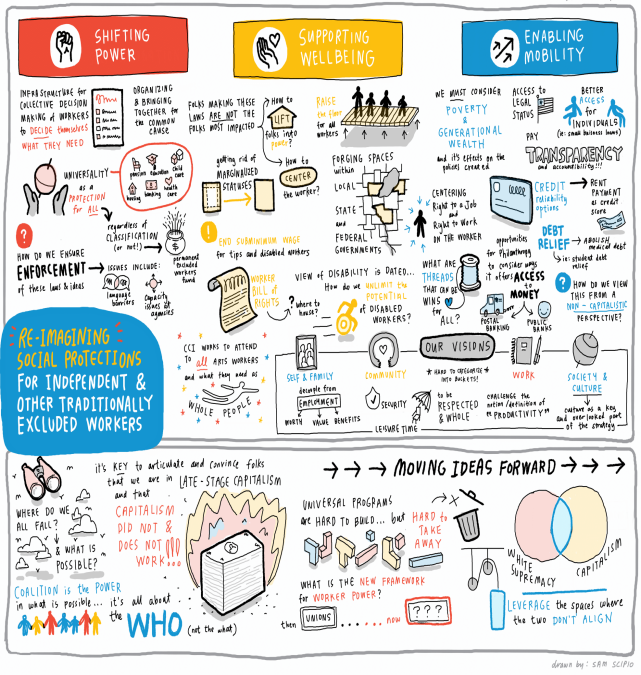
The ideas that garnered widespread support were pretty inspiring, and start to paint the picture, and the true possibility, of an alternative system of protections that isn’t contingent on your specific job or identity as a worker, but is guaranteed to you, as a human. In particular, attendees imagined:
-
-
- Widespread adoption of guaranteed income and other cash transfer programs that offer a floor of protections for all workers regardless of employment status
-
- Improvement of key social insurance programs, including healthcare, unemployment insurance, and retirement to make them affordable, portable, and universally available to everyone, regardless of their employment status
-
- The establishment of a national worker bill of rights that would apply to all workers, regardless of sector, occupation, or employment status
-
- Robust enforcement of labor laws and worker protections across all sectors
- Exploration of new models for building and wielding collective power, like sectoral bargaining
-
Driving the discussion were some core ideas – and really cultural and narrative shifts – that we, as a society, need to grapple with.
-
-
- We need to decouple work from worth.
-
- All people deserve dignity.
-
- We are full humans deserving support, not just in the narrow confines of our identities as workers.
-
- Our labor is more than the labor we do to earn income. It is the labor we do to support our families, to strengthen our communities, and to express ourselves that makes life worth living.
- A just society recognizes the value of people as humans, and builds systems to support broader human flourishing.
-
As inspiring as the visioning was, at times participants raised the challenges that stand in the way of moving from the systems we have to the systems we want, especially given the current political forces shaping policy today. And yet, there was palpable energy in the room around building greater connectivity and connection across these groups, to build greater collective power between and among nontraditional workers across sectors.
Yes, the challenges are great, but if we can align ourselves around a shared vision, we can start to build bridges to get from here to there.
You can read the full summary of the convening here. We, of course, welcome your voice in this ongoing conversation.
Convening Summary: Reimagining Social Protections For All
Convening Summary: Reimagining Social Protections For All
A Summary of the Virtual Convening on Reimagining Social Protections for Independent and Other Traditionally Excluded Workers
This December 2022 convening brought worker advocates and movement leaders together to reimagine social protections for all.
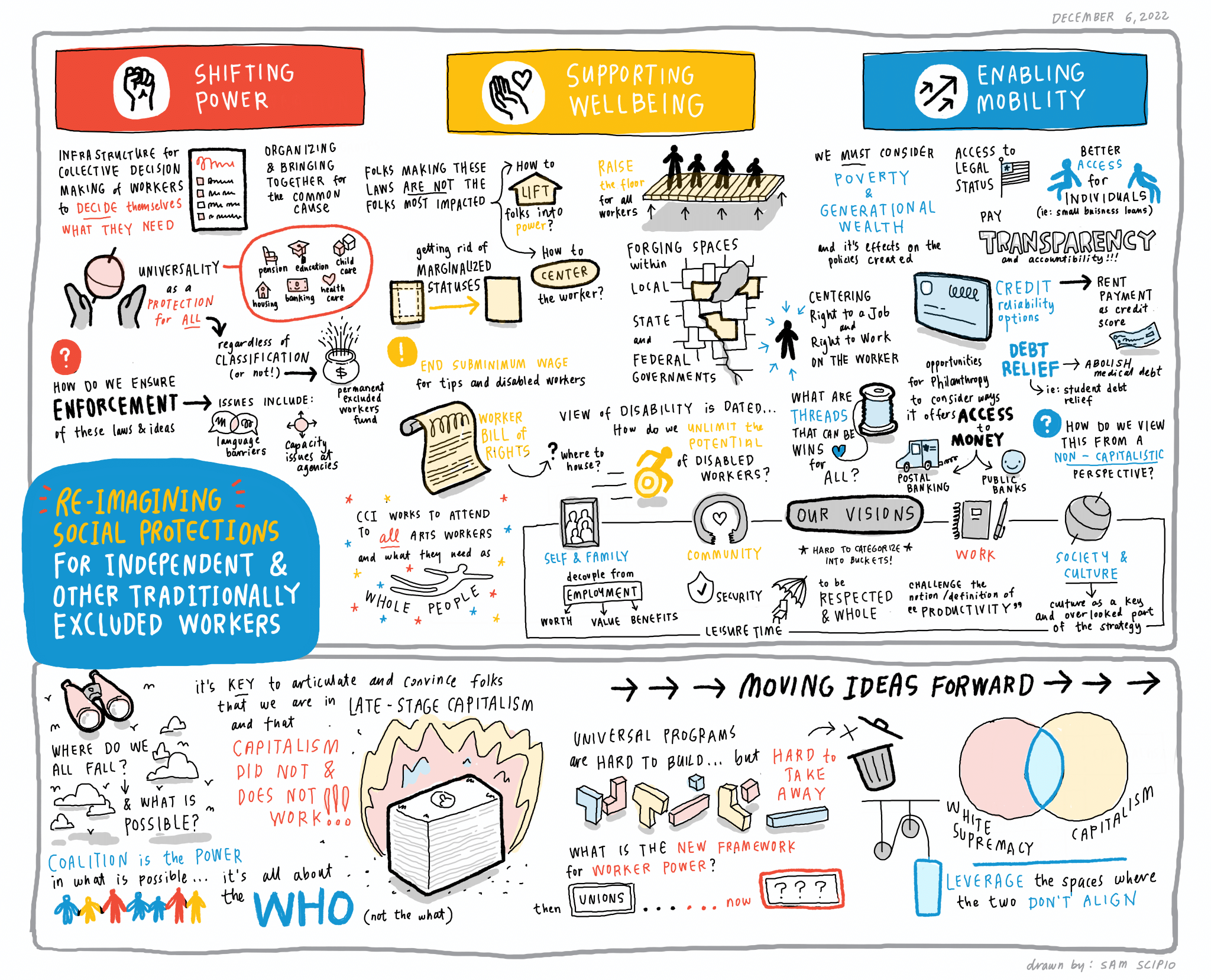
This summary describes the discussions at a virtual convening titled “Reimagining Social Protections for Independent and Other Traditionally Excluded Workers” and includes an artist's live visual notes taken during the event. We collaborated with the Urban Institute to host this convening in December 2022.
During this event, worker advocates, forward thinkers, and movement leaders imagined new systems of worker supports, protections, and power for those excluded from existing benefits and social protections, including independent contractors, temp workers, and workers in the arts.