
Whose Future Is AI Building? Advocating for Artists in the Age of Artificial Intelligence
An artist, a new university graduate, and a software engineer walk into a bar— what do they all have in common? Many things I’m sure, but one thing I could bet on and it is: fear and loathing of the growing mass adoption and overarching narrative of Artificial Intelligence (AI). Nowadays, the subject of AI feels as commonplace as discussing the weather with your neighbor. It also feels as charged a topic as politics. Admitting you use chatGPT can feel equivalent to confessing you actively support polluting Earth’s drinking water!
In fact, the subject seems to span age, culture, and sector because of just how much the technology has infiltrated our daily lives. The truth is that whether we’ve opted in or not, AI is truly everywhere, yet many of the realities of how it works and what data it’s using to generate answers and art for us are hidden. Humans have long used technology to improve our quality of life; just as artists have long used technology to support their practice. So, why does this matter so much now?
AI works by being trained on data, our human data, more often than not, without our consent. And with current dominant narratives surrounding AI technology, the mass adoption of the technology is framed as if our use of it is inevitable and something we must succumb to quickly or we might somehow blink and end up an unhirable caveman. However, the mass adoption of AI is not something inevitable like gravity, but is something that companies and the people behind them are actively investing in and we need to intentionally regulate. This matters for all sectors, but especially for the arts and culture sector, where the majority of working artists represent small businesses whose artistic works and copyright are their primary assets for making a living.
Because of the direct impact this technology has on individual artists, Research to Impact Lab (R2i Lab) monitors both how philanthropy supports AI technology (and artists’s use of it) and legislative attempts at regulation. For philanthropic funders, we have developed baseline questions for understanding the technology and how to best fund it through an ethical lens, as in our October 2024 paper, Learnings and Ethical Considerations: A Resource for Arts Funders on Artificial Intelligence.
Recently, we had the opportunity to work with our longtime partners at Stanford University’s Juelsgaard Intellectual Property and Innovation Clinic (JIPIC) to advocate for individual artists by submitting a public comment on artificial intelligence and copyright to the California State Senate’s Privacy, Technology and Consumer Protection Committee. California is a hub for both technology and artistic production, and therefore provides an opportunity to be a leader in modeling new legislation that other states could follow. It was crucial to us to submit a public comment that represents the concerns of our constituency of non-unionized individuals in the arts and at the same time showcases the key learnings from our AmbitioUS initiative and their work with cultural changemakers and community ownership experiments. With this lens, our public comments make known the current power imbalances between big tech and individual artist entrepreneurs. It also highlights the need for heightened transparency and the importance of empowering creators to more actively participate in data governance.
Being an artist in our current society already has many barriers to entry, such as having the time, space, and resources to create and sustain your practice. As we’ve seen through our many years supporting artist entrepreneurs in the (now-sunsetted) Business of Art program, our current economic system also expects artists to not only produce works of art, but also hold the responsibility of running an entire business from finance, marketing, and legal protections. So, when we talk about power imbalance, we are speaking to the unfair reality that in our current landscape of data governance and protections, individual artist entrepreneurs are meant to go head-to-head with the resources and relationships of the tech giants of Silicon Valley. Our public comments provide many ideas for how to rebalance power, but a major theme we chose to emphasize is the importance of developing legislation that supports artist-owned infrastructure.
What’s Next? These public comments are part of a larger effort towards developing legislation that oversees artificial intelligence in California. There may be more opportunities to continue to voice our opinions and respond to their findings and reflections from these hearings. If you would like to follow along with our efforts in ensuring the voices of our constituency are heard, subscribe to our newsletter to stay abreast to the most up-to-date opportunities to share your first-hand experiences.
Want to go more in-depth in the public comments R2i Lab submitted to California Senate Privacy, Technology and Consumer Protection Committee? Follow the link below for the full public comment.

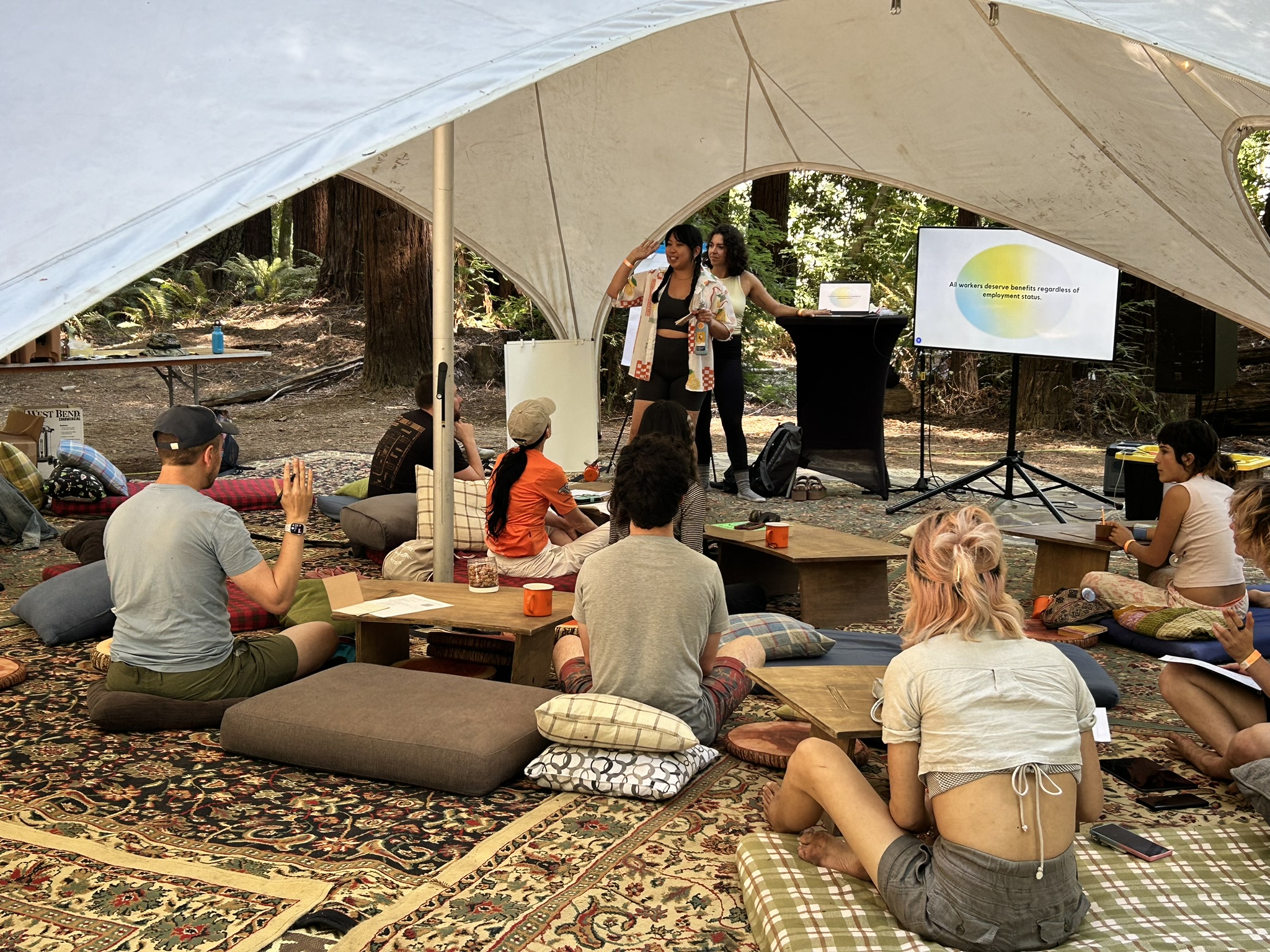
CCI at DWeb Camp 2024
CCI at DWeb Camp 2024
Reflections on our Co-Design and path forward
Systemic change to legitimize gig work won't come from band-aid solutions.
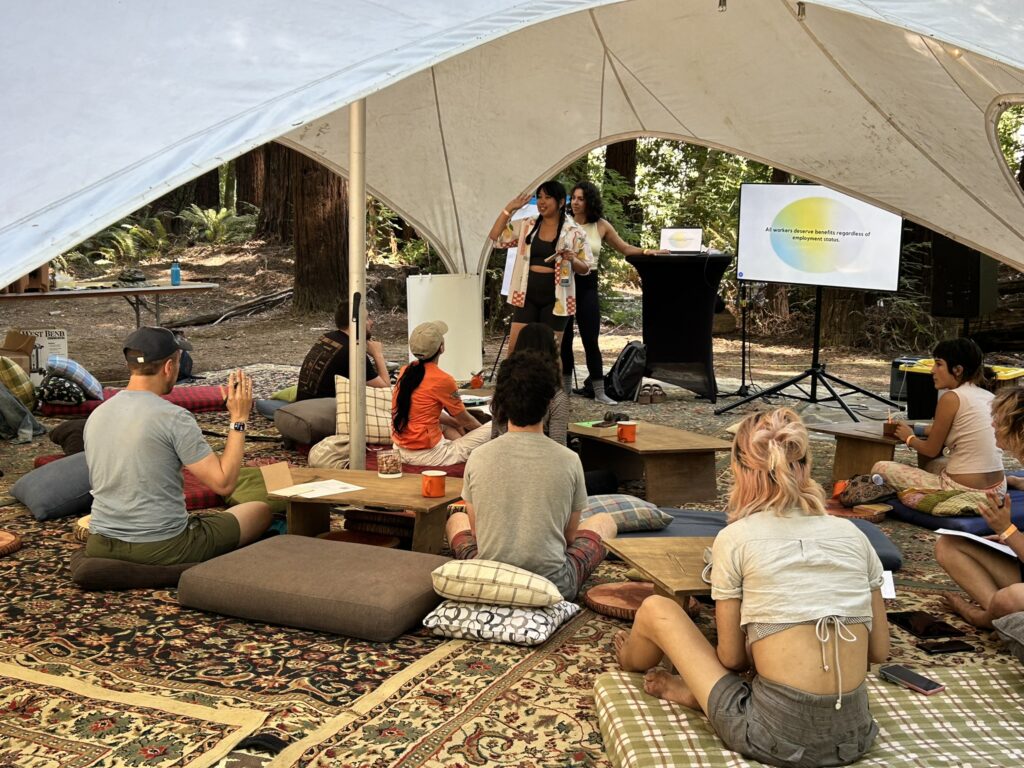
Research to Impact Lab's Senior Program Associate, Jennelyn Tumalad Bailon, and Enterprise Development Consultant, Val Elefante, facilitated a co-design for our gig worker savings club incubation project, currently known as "Cookie Jar Collective."
We welcomed 27 participants interested in helping us build a product that could facilitate shared accountability, community, and collective power centered on growing savings for gig workers.
Participants heard an overview of the purpose and journey CCI has taken to reach this point. They also spent time brainstorming and drawing different aspects of the product ranging from governance, UX design, and tech stack.
Watch the in-depth overview of our presentation, key takeaways, and next steps for this project in the video below.

Learnings and Ethical Considerations: A Resource for Arts Funders on Artificial Intelligence
Learnings and Ethical Considerations: A Resource for Arts Funders on Artificial Intelligence
A helpful resource for funders interested in moving ethically in the Artificial Intelligence (AI) space
As Artificial Intelligence (“AI”) transforms various sectors, it is crucial to evaluate both the pros and cons of AI-integrated projects. As arts’ funders, it is our duty to safeguard human creativity, ownership rights, and data privacy for creators and cultural communities in grantmaking processes.
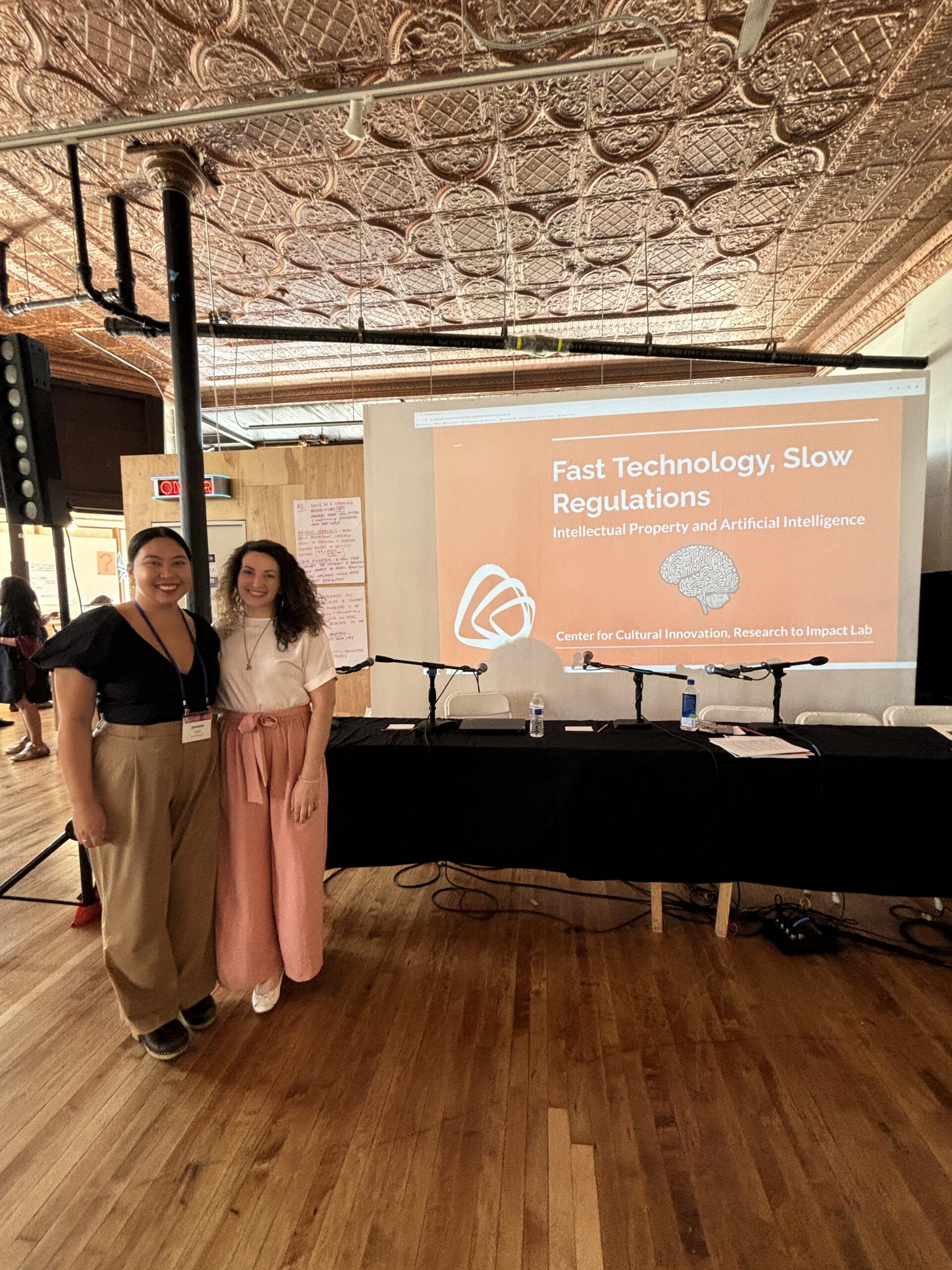
Research to Impact Lab staff designed a workshop for the 2024 Grantmakers in the Arts' Support for Individual Artists Preconference: The Future is AI? Equipping Artists for the Digital Renaissance.
The R2I Lab’s workshop, Fast Technology, Slow Regulations: Intellectual Property and Artificial Intelligence, featured a discussion on current AI regulations as well as the ethical and social implications amid rapid technology adoption and limited data protection measures.
The workshop featured tangible and immediate protections that funders can support to address artists' intellectual property concerns and offered strategic possibilities for funders interested in supporting more structural changes impacting individual artists and vulnerable communities.
The workshop finished with a hands-on activity where funders could practice intentional discovery and due diligence on a project involving AI technology.
This resource expands on the workshop content, providing a comprehensive list of due diligence questions and implementation strategies for arts funders evaluating AI-integrated project proposals.

Are you an artist or creative worker who has dealt with an issue related to copyright?
Are you an artist or creative worker who has dealt with an issue related to copyright?
Help us protect artists' intellectual property (IP)
As defined by the U.S. Copyright Office, Copyright is a type of intellectual property (IP) that gives the creator of an original work the right to copy, distribute, adapt, display, and perform that work for a limited time.
To protect their livelihoods, artists must learn how to protect their work from copyright infringement, as well as other lesser-known copyright claims that can impact an artist’s livelihood such as noninfringement and misrepresentation.
Before the Copyright Claims Board (CCB) was created in 2020, smaller independent artists often did not have many cost or time-effective options to seek legal action when experiencing issues related to their own intellectual property (IP). This is why the CCB was created: to answer an urgent need – the large volume of copyright claims and the limited amount of resources (time, expertise, money) available to creators to make those claims in federal court.
However, even with this new resource for protecting artists, there are still many ways artists issues can fall through the cracks. Help us understand your stories related to copyright. What issues are you dealing with? What systems are out there that you are falling through? What potential copyright issues are keeping you up at night? We want to hear from you!
Thank you so much for sharing your story! We will use these examples to shape our advocacy, research, and resources on this topic, and may reach out to you for more information, or to let you know about opportunities to advance social and economic protections for all.
Navigating the Copyright Claims Board: A Practical Guide for Creators
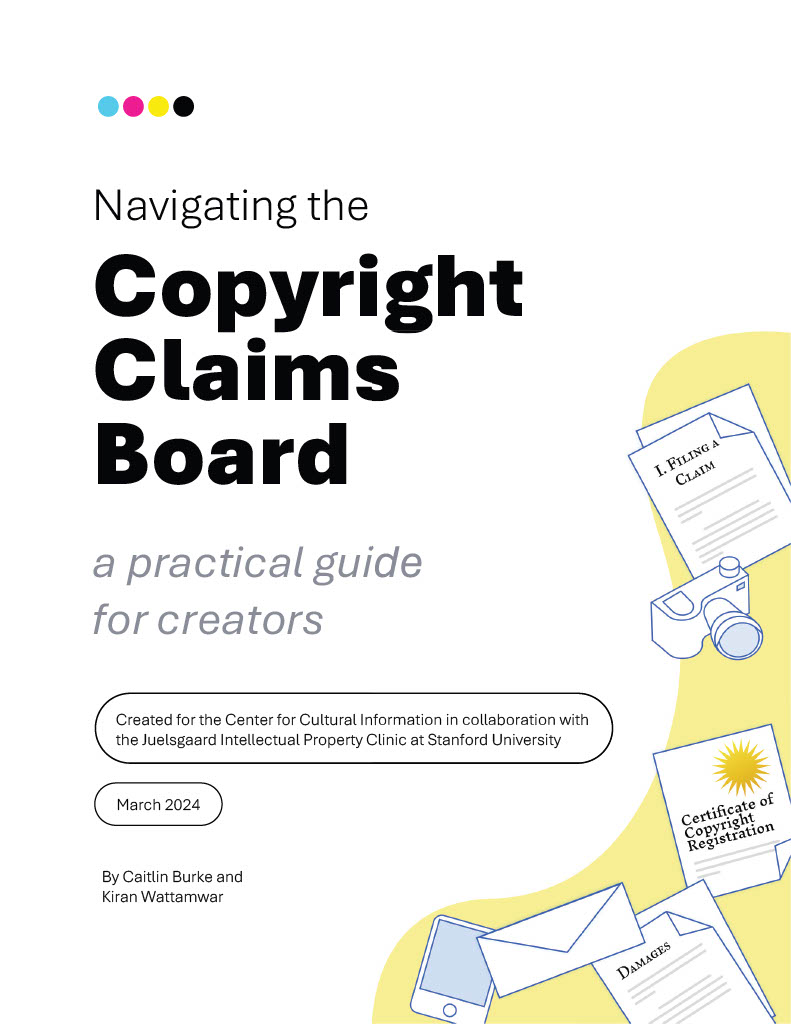
Navigating the Copyright Claims Board: A Practical Guide for Creators
A guide for creatives to better understand the Copyright Claims Board (CCB). This resource was created through a partnership between The Center for Cultural Innovation (CCI) and Stanford University's Juelsgaard Intellectual Property and Innovation Clinic (JIPIC)
Thank you so much for sharing your story! We will use these examples to shape our advocacy, research, and resources on this topic, and may reach out to you for more information, or to let you know about opportunities to advance social and economic protections for all.
Navigating the Copyright Claims Board: A Practical Guide for Creators would not have been possible without the support of the William & Flora Hewlett Foundation and the Kenneth Rainin Foundation

Supporting Confident Creativity
Stanford and CCI Partner to Help Creatives with their Copyright Claims
For the vast majority of artists, some interaction with technology is not only unavoidable - it is necessary to rapidly create, produce and disseminate work as well as to ensure compensation. From blockchain to NFTs to Etsy, creatives use technology to connect directly with those who support their artwork. However, such technologies have also made it incredibly easy for that artwork to be pirated or misattributed. To protect their livelihoods, artists must learn how to protect their work from copyright infringement, as well as other lesser-known copyright claims that can impact an artist’s livelihood such as noninfringement and misrepresentation. The Copyright Claims Board (CCB) was created to make this process easier and less expensive for the average creator.
The Copyright Claims Board (CCB) was established in 2020 by Congress to answer an urgent need - the large volume of copyright claims and the limited amount of resources (time, expertise, money) available to creators to make those claims in federal court. The CCB consists of an entirely online process led by a three-member tribunal with extensive expertise in copyright law. The goal is a more efficient, less expensive alternative to federal court for copyright claims of less than $30,000.
And yet, like any bureaucratic process, this one can be challenging for those without an understanding of intellectual property law. CCI felt that it was critical to create a resource specifically for creatives so that they might learn how to navigate the CCB to protect their intellectual property rights. Through a partnership with the incredible students and staff of Stanford University’s Juelsgaard Intellectual Property and Innovation Clinics, we have created a live online resource for creatives to confidently navigate the CCB called Navigating the Copyright Claims Board: A Practical Guide for Creators!
What makes Navigating the Copyright Claims Board: A Practical Guide for Creators so special? Our Juelsgaard Clinic students found that since opening, the CCB has only seen a success rate of 1.5% of claims reaching a final decision (that is only 12 claims out of 721 filed).
This jaw-dropping number sparked our interest - how is it possible that a public resource set up to encourage independent creatives to take control of their IP should see such a dismal success rate? Our hope is that with this more accessible and interactive guide, artists and creative workers will feel more confident in their copyright claims.
To celebrate the release of this resource, please join us for the following activities:
-
- Confidently Informed: Navigating the Copyright Claims Board for Creatives on Thursday, June 6: a virtual workshop with the authors of the resource, Caitlin Cary Burke, Juelsgaard Clinic Member, Stanford J.D/PhD Candidate, 2025; and Kiran Wattamwar, Juelsgaard Clinic Member, Stanford J.D Candidate, 2025. Participants will get a tour of the guide and the chance to ask its authors any questions they might have about copyright protections. Register here!
- Confidently Registered: a Copyright Registration Party! on Thursday, June 20. CCI will host a virtual registration party! Register your copyright online with the Copyright Office. CCI staff will be on hand to assist you through the process. Register here!
- Share Your Story! Are you an artist or creative worker who has dealt with an issue related to copyright? If so, then share your story with us below! We’ll add it to a story bank to help us understand how we can support creatives with their copyright issues.
- Ongoing Activities. CCI will host resources and gatherings related to the needs of artists and in response to the research. Interested in partnering on this initiative? Contact Jennelyn Bailon at jennelyn@cciarts.org
CCI would like to thank the team from Stanford for making this resource possible:
Caitlin Cary Burke, Juelsgaard Clinic Member, Stanford J.D/PhD Candidate, 2025
Kiran Wattamwar, Juelsgaard Clinic Member, Stanford J.D Candidate, 2025
Phil Malone, Director of Juelsgaard Intellectual Property and Innovation Clinic, Mills Legal Clinic, Stanford Law School
Nina Srejovic, Clinical Supervising Attorney and Lecturer, Juelsgaard Intellectual Property and Innovation Clinic
Navigating the Copyright Claims Board: A Practical Guide for Creators would not have been possible without the support of the William & Flora Hewlett Foundation and the Kenneth Rainin Foundation