

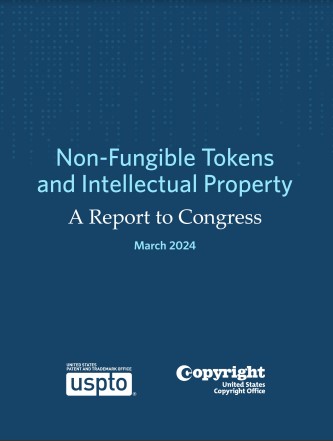
Non-Fungible Tokens and Intellectual Property: A Report to Congress
Non-Fungible Tokens and Intellectual Property
A Report to Congress
The United States Patent and Trademark Office and United States Copyright Office
United States Patent and Trademark Office (USPTO) is the federal agency for granting U.S. patents and registering trademarks. The U.S. Copyright Office promotes creativity and free expression by administering the nation’s copyright laws and by providing impartial, expert advice on copyright law and policy for the benefit of all.
NFTs provide both opportunities and challenges for creators. Learn more about both in this new report to Congress.
A Report to Congress prepared by the United States Patent and Trademark Office and United States Copyright Office about how intellectual property laws apply to NFTs and specific intellectual property-related challenges arising from the use of NFTs. Public comment gathered and prepared by CCI’s Advocacy program is cited (previously, Sol Center for Liberated Work).

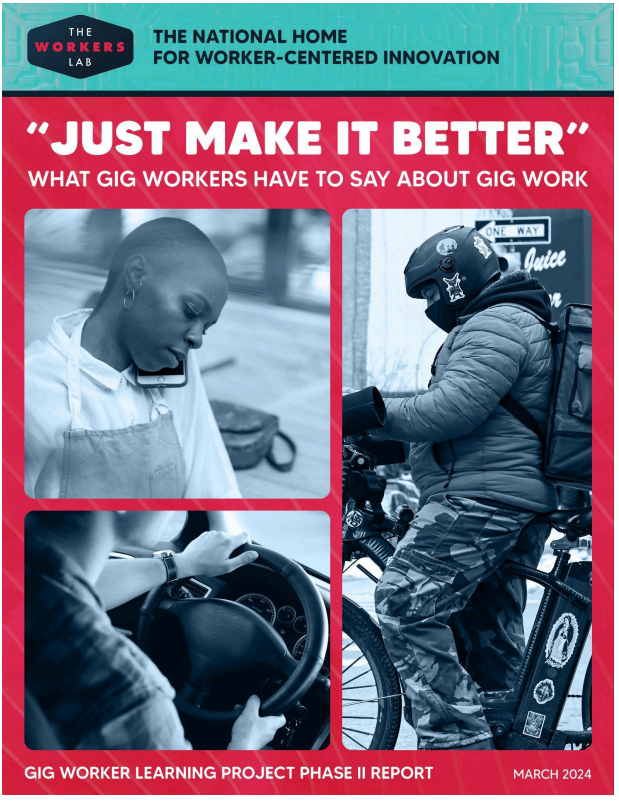
Gig Worker Learning Project: Phase Two Report
Gig Worker Learning Project: Phase Two Report
"Just Make It Better." What Gig Workers Have to Say About Gig Work
The Gig Worker Learning Project is a valuable resource for anyone seeking to better understand gig workers and the challenges they face.
Supported by CCI, led by The Workers Lab, and developed in collaboration with the Aspen Institute Future of Work Initiative, “Just Make It Better. What Gig Workers Have to Say About Gig Work” is a unique new piece of research on “gig” work, co-authored by active gig workers as participant-researchers. The goal of this project is to better understand gig work and workers directly from gig workers themselves, regarding their motivations, challenges, and solutions that would impact their lives personally and professionally.
Arts Worker Supports Issue Brief
Arts Worker Supports - Issue Brief
A summary of the public policies needed to build economic security for arts workers and microbusinesses
We worked with arts advocates to define a policy agenda that supports arts workers and microbusinesses.
In Spring/Summer of 2023, we worked with a voluntary group of arts worker advocates through the Cultural Advocacy Group to identify a set of policies needed to support the economic security of arts workers and microbusinesses. This issue brief is the result of our collective effort.
The brief summarizes the challenges people working in the arts face to access social protections, both as independent workers and microbusinesses, and outlines a series of policy reforms needed to build a safety net for all.
The brief is meant to be a resource for the field, so please feel free to use it in your own advocacy!
Imagining Social Protections for All
Imagining Social Protections for All
Bringing together worker advocates and movement leaders to imagine new systems of protection
Althea Erickson
Althea Erickson is the Director of the Sol Center for Liberated Work, a program of the Center for Cultural Innovation. Previously, Althea was the Vice President of Global Government Affairs and Impact at Etsy, and Advocacy & Policy Director at Freelancers Union.
Sometimes when we’re living inside a system, it’s hard to imagine what an alternative could look like.
In our desire to make progress–to improve the way things work–we focus on a tweak here, a shift in implementation there. And to some extent, that can be a good and pragmatic strategy. But it has its downsides.
When we seek to fix the systems we live in, we may unintentionally reinforce and entrench ones that simply don’t work, and worse, undermine our hope of achieving more. For example, the U.S. social safety net excludes huge swaths of workers–domestic workers, farm workers, self-employed workers, sex workers, and undocumented workers, just to name a few. Some of these groups were explicitly excluded to appease Southern segregationists, while others were merely overlooked due to the nature of the economy at the time. To date, much of the effort to close those gaps has been to focused on expanding existing systems to new populations, for example including domestic workers in labor laws or excluded workers in unemployment insurance. But what if the 21st century work force simply doesn’t fit into 20th century systems?
What if we started fresh, and reimagined a set of social and economic protections that met the needs of today’s workforce, unencumbered by the past? And what if we started that conversation with the workers who have been erased from the conversation, yet are most excluded from today’s safety net? What types of protections might we imagine together? And wouldn’t that system be more likely to actually work for all?
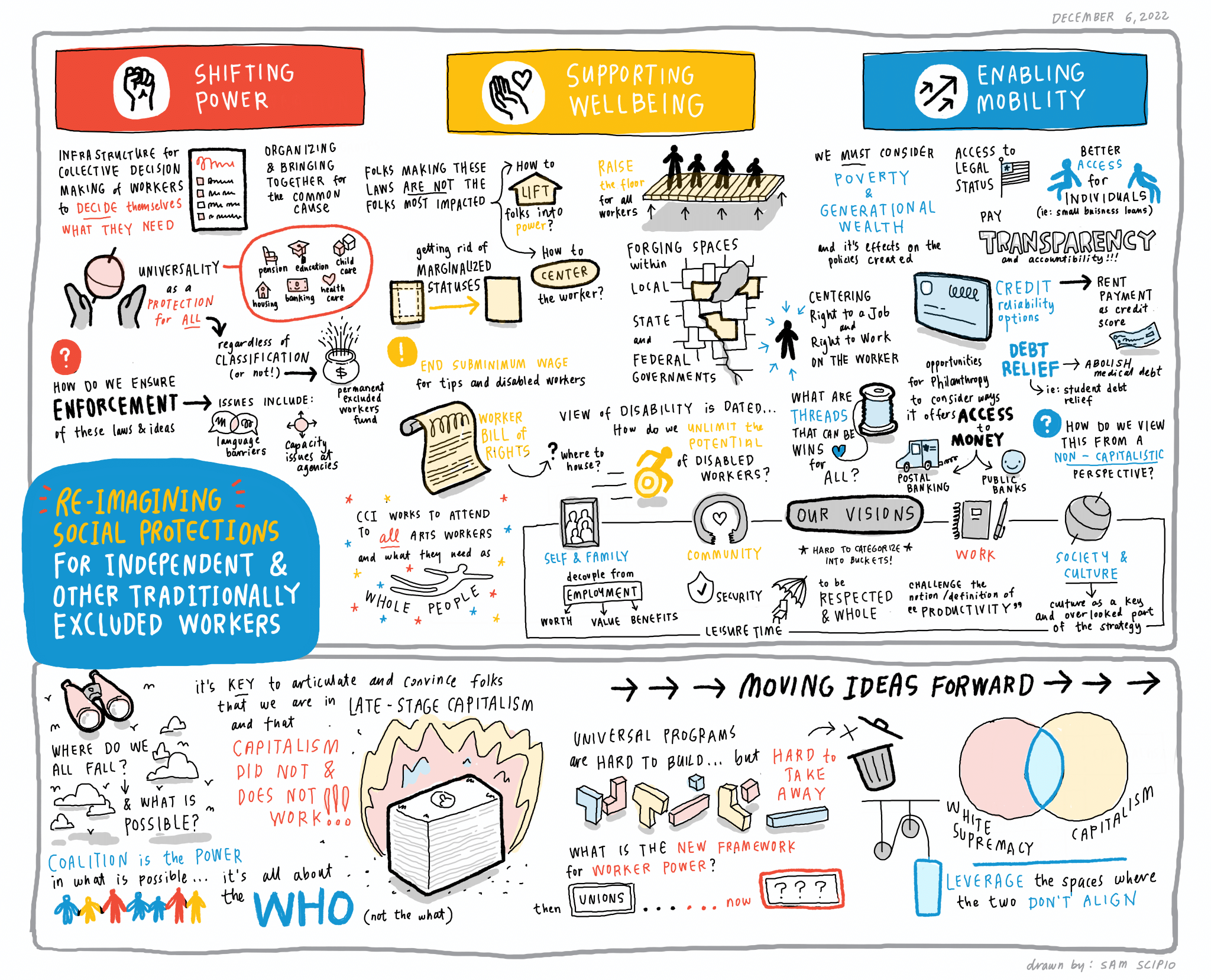
Those questions underpinned Reimagining Social Protections for Independent and Other Traditionally Excluded Workers, a convening we co-hosted with the Urban Institute in December 2022. The convening brought together worker advocates representing nontraditional workers from across a wide swath of sectors–domestic workers, migrant workers, temp workers, street vendors, migrant workers, sex workers, and more. Together, we set aside the constraints of today’s systems, and gave ourselves permission to imagine an alternative vision of economic security for today’s workforce, to dream beyond barriers of all kinds.
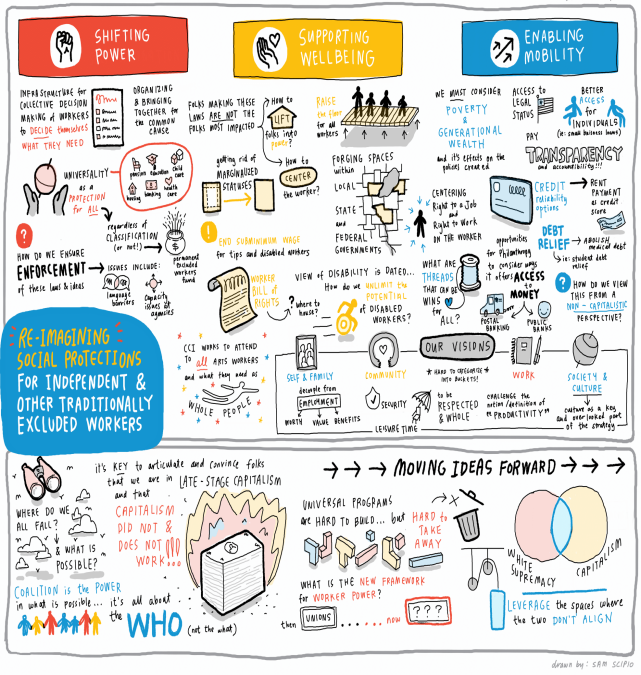
The ideas that garnered widespread support were pretty inspiring, and start to paint the picture, and the true possibility, of an alternative system of protections that isn’t contingent on your specific job or identity as a worker, but is guaranteed to you, as a human. In particular, attendees imagined:
-
-
- Widespread adoption of guaranteed income and other cash transfer programs that offer a floor of protections for all workers regardless of employment status
-
- Improvement of key social insurance programs, including healthcare, unemployment insurance, and retirement to make them affordable, portable, and universally available to everyone, regardless of their employment status
-
- The establishment of a national worker bill of rights that would apply to all workers, regardless of sector, occupation, or employment status
-
- Robust enforcement of labor laws and worker protections across all sectors
- Exploration of new models for building and wielding collective power, like sectoral bargaining
-
Driving the discussion were some core ideas – and really cultural and narrative shifts – that we, as a society, need to grapple with.
-
-
- We need to decouple work from worth.
-
- All people deserve dignity.
-
- We are full humans deserving support, not just in the narrow confines of our identities as workers.
-
- Our labor is more than the labor we do to earn income. It is the labor we do to support our families, to strengthen our communities, and to express ourselves that makes life worth living.
- A just society recognizes the value of people as humans, and builds systems to support broader human flourishing.
-
As inspiring as the visioning was, at times participants raised the challenges that stand in the way of moving from the systems we have to the systems we want, especially given the current political forces shaping policy today. And yet, there was palpable energy in the room around building greater connectivity and connection across these groups, to build greater collective power between and among nontraditional workers across sectors.
Yes, the challenges are great, but if we can align ourselves around a shared vision, we can start to build bridges to get from here to there.
You can read the full summary of the convening here. We, of course, welcome your voice in this ongoing conversation.
Convening Summary: Reimagining Social Protections For All
Convening Summary: Reimagining Social Protections For All
A Summary of the Virtual Convening on Reimagining Social Protections for Independent and Other Traditionally Excluded Workers
This December 2022 convening brought worker advocates and movement leaders together to reimagine social protections for all.
This summary describes the discussions at a virtual convening titled “Reimagining Social Protections for Independent and Other Traditionally Excluded Workers” and includes an artist's live visual notes taken during the event. We collaborated with the Urban Institute to host this convening in December 2022.
During this event, worker advocates, forward thinkers, and movement leaders imagined new systems of worker supports, protections, and power for those excluded from existing benefits and social protections, including independent contractors, temp workers, and workers in the arts.
NFTs, Smart Contracts, & DAOs
NFTs, Smart Contracts, & DAOs
A Resource for Creatives
A report to help creatives capture the opportunities of blockchain technologies, while protecting themselves from legal risk
When we started seeing many BIPOC artists moving into the blockchain space several years ago, we started building our own expertise in this area.
That’s why we commissioned Alex Glancy at Gundzik Gundzik Heeger LLP to author this report exploring the legal challenges artists face on the blockchain.
To support creatives as they engage with this new technology, this report seeks to provide information in the legal areas of copyright, business entities, securities, contracts, and trademark, as applied to these emerging tools.
Ultimately, we hope this report serves as a resource to help creatives capture the opportunities of blockchain technologies, while protecting themselves from the risks.